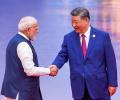
India's dual pursuit of a robust strategic partnership with Washington and a pragmatic, tension-management policy with Beijing represents the essence of modern multi-alignment. By embracing economic pragmatism, learning to compartmentalize political differences, and engaging in continuous dialogue, India can secure its borders, grow its economy, and contribute to a stable, multipolar Asian century, points out Ambassador Rajasekhar.

Prime Minister Narendra Modi and Indonesian President Prabowo Subianto have significantly advanced the India-Indonesia Comprehensive Strategic Partnership, securing crucial agreements on defence, critical minerals, and maritime security, including BrahMos missile supply and Sabang port development.

By appearing to privilege ideological affinity over strategic balance, India risks eroding the trust painstakingly built across West Asia. Once the perception takes hold that India's friendship is conditional and transactional, rebuilding credibility will be difficult, warns Amberish K Diwanji.

History may remember Takaichi Sanae not as the leader who simply accelerated Japanese rearmament, but as one who governed during Japan's transition from an industrial-age security model to a post-industrial strategic member of the global order, points out Varun Arya.

By taking one of the oldest stories and finding new meaning within it, Christopher Nolan has created the most timely film of his career, asserts Mayur Sanap.
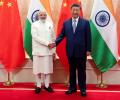
Chinese Foreign Minister Wang Yi has called on India and China to view each other as partners rather than rivals, emphasising the importance of cooperation for regional stability and development.

French President Emmanuel Macron's recent state visit to India concluded with a tribute video featuring the title track from the Hindi blockbuster 'Dhurandhar,' sparking widespread social media buzz.

India has joined the US-led 'Pax Silica' alliance, aimed at building a resilient supply chain for critical minerals and artificial intelligence, marking a significant step in strengthening bilateral ties and fostering economic security.
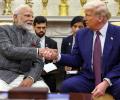
The new US national security strategy signals a retreat from global dominance while reaffirming continuity in India's role in Indo-Pacific security and Quad cooperation, points out former foreign secretary Shyam Saran.

'India has the deciding vote in the 21st century...India is a significant player in the 21st century and is poised to become even more powerful.'
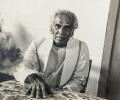
What appeared to be a generous act of friendship was, in truth, a manoeuvre within a much larger strategic game. The United States used the 1962 war not just to aid India but to test how far it could be pulled into the Western fold, points out Dr Kumar.

In the foreword of the autobiography titled I am Giorgia -- My Roots, My Principles brought out by Rupa Publications, Modi says the book, "gives readers a candid and rare glimpse into the heart and mind of one of Europe's and the world's most dynamic and vibrant leaders."

'The biggest point of contention is market access for US agricultural and dairy products.'
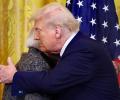
'For the region and for the world, the US working with both those nations is good news.'

West Bengal Chief Minister Mamata Banerjee, on an official visit to the United Kingdom, took a refreshing jog in London's Hyde Park, wearing a white saree and her signature white slippers. Banerjee also attended a high tea reception at India House, hosted by Vikram K Doraiswami, the High Commissioner of India to the United Kingdom, bringing together business, cultural, and political leaders to strengthen ties between Bengal and Britain. The discussions centered around fostering economic partnerships and deepening people-to-people connections.

'If Washington has to balance Chinese power, she will have to turn to the third biggest power in the world which is India.' 'The United States and India will have to work together in order to keep Chinese ambitions in check.'

'...it should not delude itself into thinking that India's security or its great-power ambitions will be advanced by those partnerships.'
'Instead, what India should focus on is on riding out the next three-and-a-half years of Trump's presidency with minimal damage to itself.'

India's pharmaceuticals and medical devices industries are still hopeful that trade negotiations with the US could cut a fairer deal for both sides, after President Donald Trump announced a 25 per cent tariff rate on India on a social networking platform without divulging the finer details.
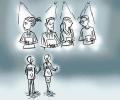
Despite the alarming figures on job displacement, AI is expected to generate millions of new roles, echoing historical trends of technological transformation.

Russia's unprecedented rapprochement with North Korea has raised concerns about the re-emergence of a Russia-China-North Korea alliance which could increase the probability of conflict on the Korean Peninsula, explains Dr Rajaram Panda.

The compulsion behind India and Japan to deepen security cooperation is in response to China's growing political and economic clout and its assertive behaviour in disputed areas. This has been the key driver for bringing both India and Japan closer in the domain of security cooperation, explains Dr Rajaram Panda.

'A less tense US-China relationship would make Beijing less likely to provoke India -- including on the border -- in retaliation for its close defence ties with the US.'

Anticipating US action on tariffs, India seems to have made the first move by revamping its tariff structure by reducing the slabs to eight rates, points out Mukesh Butani.
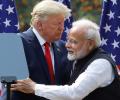
'Trump will absolutely back New Delhi on its position that Pakistan must do more to crack down on terrorists that threaten India.'

Reports (not denied by India) that the USA had 'for the first time provided real-time details to their Indian counterparts on the Chinese positions and force strength in advance of a PLA incursion' into Tawang at the LAC in December 2022, helping India thwart China's expansionist designs, show how operationally effective the USA-India friendship has become on the ground. A engaging excerpt from Sreeram Chaulia's must-read new book, Friends: India's Closest Strategic Partners.

Prime Minister Narendra Modi said he looks forward to useful conversations with his fellow leaders from China, South Africa, Brazil and Russia on addressing pressing international and regional challenges that stand in the way of their goals.

The US is looking very carefully at what Modi did when he was in Moscow, a senior State Department official has told lawmakers concerned over the growing India-Russia ties.

US India Business Council has urged New Delhi and America to take steps to strengthen bilateral trade relationship to realise their 'true business potential'.

Joe Biden's B3W proposal aims to bring democracies together. India should come up with its own plans to contribute to the initiative, states Rahul Mishra.

Modi was honoured with the 'Order of Zayed', the UAE's highest civilian award, in 2019 as a mark of appreciation for his efforts to boost bilateral ties between the two nations.

'The Modi government will do well to thrash out a national consensus before taking the leap and put itself in America's pouch,' says Rajeev Sharma.

The Indian armed forces, especially the Navy, are building partnerships in the Indo-Pacific region for peace and security, as well as humanitarian assistance and disaster relief, he said.

Prime Minister Narendra Modi on Saturday began his maiden state visit to Egypt by holding discussions with his Egyptian counterpart Mostafa Madbouly and top cabinet ministers on deepening trade relations and further strengthening the strategic partnership.

'India's specific concerns about whether Russia will be a reliable defense supplier and diplomatic partner in the event of heightened hostilities with China has undoubtedly accelerated the process of US-India defense and intelligence cooperation intended to support Indian military positions along the Line of Actual Control.'

Ahead of his crucial talks with Russian President Vladimir Putin in Moscow, Chinese President Xi Jinping said on Monday that his peace plan to end the raging Ukraine war takes into account the 'legitimate' concerns of all parties and reflects the broadest common understanding of the international community.

Prime Minister Modi also made a veiled reference to China, saying the global order is based on the respect for the principles of the UN Charter, peaceful resolution of disputes, and respect for sovereignty and territorial integrity.
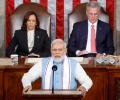
Here's the full text of Prime Minister Narendra Modi's address to a joint session of the United States Congress, delivered on Thursday.

'It's vital that over the next 10 years, that India, the US and the Artemis Accords family of nations come together to ensure that we not only return humanity to the moon, but that we build the technology that will allow us stay there permanently.' 'And then go on to Mars.'
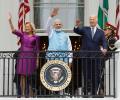
The constitution of both countries begins with the "three words -- We the People -- as President Biden just mentioned", said Modi, who is on his first state visit to the US.
'India appears to have stood its ground on strategic autonomy by resisting US pressure on Russia, China and Iran, but succumbed to the temptation to walk into a tighter embrace in defence cooperation, a high priority of the Trump administration,' notes Ambassador T P Sreenivasan.
